Client
AI Personalization for LG.com
Year
2025
Timeline
10 weeks
Services
LG CNS · Commerce Website · AI Agent
AI Personalization for LG.com
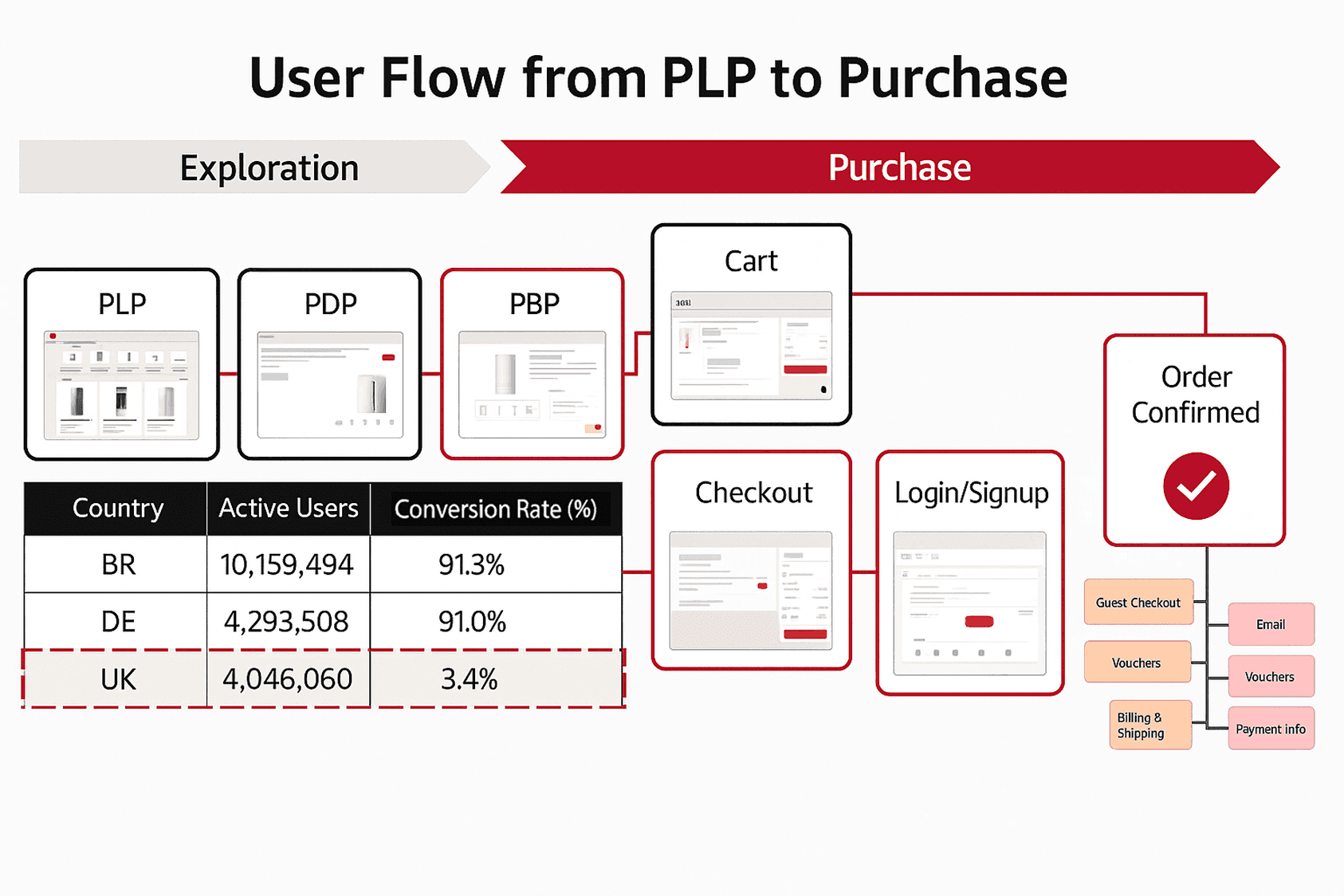
LG.com runs 36+ markets on one global platform, and the UK site had the highest engagement of any region but a purchase conversion of just 3.4%. On LG CNS's Commerce Experience Design team, I traced that gap to a mismatch between how the site presented appliances and how UK households actually choose them. I combined GA4 funnel analysis, cultural research and competitive benchmarking, then designed an AI-personalized recommendation framework that surfaces the right product for each buyer's home.

Role | Team | Timeline | Tools |
|---|---|---|---|
UI/UX Design Intern | Commerce Experience Design team (7 designers and 1 engineer) | Jan–Mar 2025 | Google Analytics (GA4), Figma, Qualitative Research, AI agents |
01 · The problem: high interest, low purchase
One pattern kept surfacing in the regional data: UK visitors explored more than almost anyone, then stopped short of buying.

UK conversion lagged far behind markets with similar traffic. Visitors clearly wanted LG appliances, so the problem wasn't attracting them. Something between browsing and deciding was breaking down, and I set out to find what.
02 · Diagnosis: three lenses on one drop-off
No single source explained the gap, so I looked at it three ways. Each answered a different question.
Lens | What I did | What it showed |
|---|---|---|
Behavior data: where do people stop? | Rebuilt GA4 data as funnels from product list to detail, basket, cart and checkout. Compared mobile and desktop, scroll depth, add-to-basket signals, and the "Frequently Bought Together" and "Our Picks for You" modules. | Visitors explored widely but hesitated at decision points, with major drop-offs on mobile. |
Cultural context: why do they stop? | Compared UK households and appliance habits with other markets. | UK homes, especially kitchens and laundry spaces, are smaller. Buyers weigh size, noise and energy efficiency first, yet the site led with large models and US/EU-standard positioning. |
Benchmarking: how do others help people decide? | Reviewed Amazon, Walmart and Samsung on product comparison, "better fit" framing, related items and trust for big purchases. | Leaders reduce comparison effort and explain why a product fits, instead of showing more products. |
Together they explained why globally best-selling models underperformed in the UK: the products weren't wrong, the context was.
03 · Reframe: not more products, the right one
The brief pointed toward optimizing a recommendation module. The research pointed somewhere bigger.
UK buyers don't need more products. They need the right product, in the right context, at the right moment.
That shifted the goal from "show more relevant items" to "help each buyer feel confident that this one fits their home." A single UI fix couldn't do that across 36 markets, so I treated personalization as a strategy for the whole page, not a widget.
04 · Design: four decisions
1. Lead with what UK buyers weigh first. Compact sizes, noise levels, energy ratings and space-related attributes moved earlier on the page, instead of waiting deep in the spec sheet.
2. Explain fit, not just newness. Recommendations show why a model suits the buyer, not only the newest or most expensive one. Confidence at the decision point is exactly where UK visitors were dropping off.
3. Localize without breaking the global system. The redesigned "Our Picks for You" module keeps LG.com's global structure, so it can scale across markets while the content adapts to each one.
4. Make priorities scannable. Color tags flag what matters at a glance: green for energy efficiency, LG red for brand-aligned cues.

05 · The system: personalization that learns
With a data analyst, I segmented UK users by their browsing behavior. Then I designed how those signals would shape the page for each visitor.
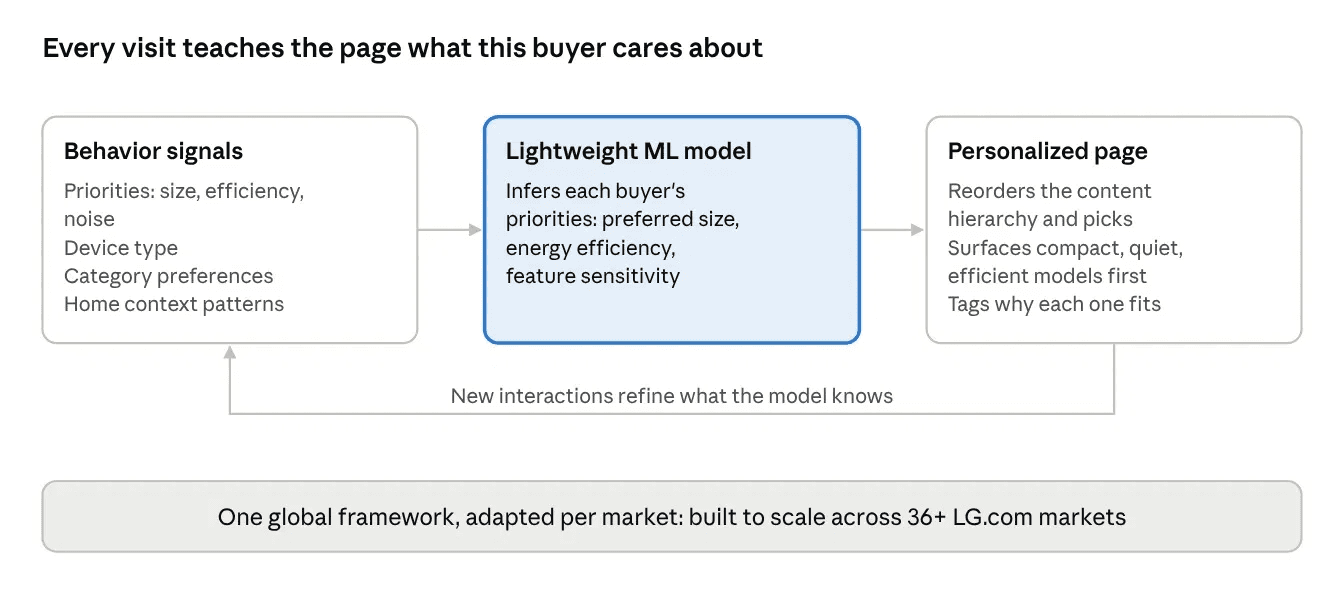
The more a buyer browses, the more the page reflects their home, while the same framework serves every market.
06 · Outcome and what's next
The framework did not ship during my internship because of timeline and system constraints. I designed it to be buildable: I partnered with data and engineering stakeholders to prepare the modules for implementation, and kept the architecture realistic enough to scale across all 36+ markets.
If I continued the project, I would:
Deploy the personalization prototype and measure how UK behavior changes at the decision point
Extend personalization beyond "Our Picks for You" to build confidence across the full journey, from product list to checkout
Because this work was done at LG CNS, some details are not shared publicly. I'm happy to walk through more in conversation.
07 · What I learned
Context is part of the product. The same appliance is a different decision in a small London flat. Global e-commerce can't run on one template; it has to adapt to how each market lives.
Numbers find the gap; culture explains it. GA4 told me where UK buyers hesitated. Only research into their homes told me why.
AI is a strategy, not a feature. Personalization only matters when it's grounded in real user priorities, and designing it pushed me from UI fixes toward system-level decisions.
Zoom out, then zoom in. Understanding the whole ecosystem first made the interface decisions easier to defend.
More work